
Selling configurable products online has always been harder than it looks. Static images and dropdown menus leave too much to the imagination. When it comes to complex or personalizable products, in our experience, imagination is rarely a reliable sales tool. This guide cuts through the marketing spiel to break down the benefits of a 3D product configurator, for your customers, your sales team and your operations.
Key take-aways
- A 3D product configurator lets shoppers build, customize or personalize a product in real-time 3D. This interactive experience removes the uncertainty that prevents purchase on complex or configurable product pages. Brands consistently report conversion rate uplifts of 30 to 40% compared to standard static product pages.
- The benefits of a product configurator go well beyond conversion. A configurator increases average order value by making premium options visible and compelling at exactly the right moment in the buying journey. It also reduces return rates by ensuring shoppers know precisely what they are ordering before they commit.
- For brands with made-to-order or B2B sales models, a configurator automates the entire quote and order workflow. From real-time pricing to production-ready file generation, it eliminates the manual steps that slow down the sales cycle and create costly errors downstream.
- Real-time 3D is the only scalable way to show customers every possible configuration of a product with a large number of options. Pre-calculated renders and photography are no longer technically or financially viable due to the sheer number of product visuals needed.
- A well-built configurator is not just a website tool. It is an omni-channel platform: the same 3D assets and configuration logic can be deployed on your eCommerce site, in-store, in a sales environment or in a B2B distributor portal, from a single shared asset library.
- Choosing the right product configuration software matters as much as the decision to deploy one. Rendering quality, rules engine accuracy and depth of integration with your existing tech stack directly determine whether you get the business outcomes described in this article.
FREE RESOURCE
3D Configurator Project Planning Template
Use our ready-to-fill, 20-question template to map out your project in under an hour and build a budget-safe, fully aligned plan from day one!

What exactly is a 3D product configurator?
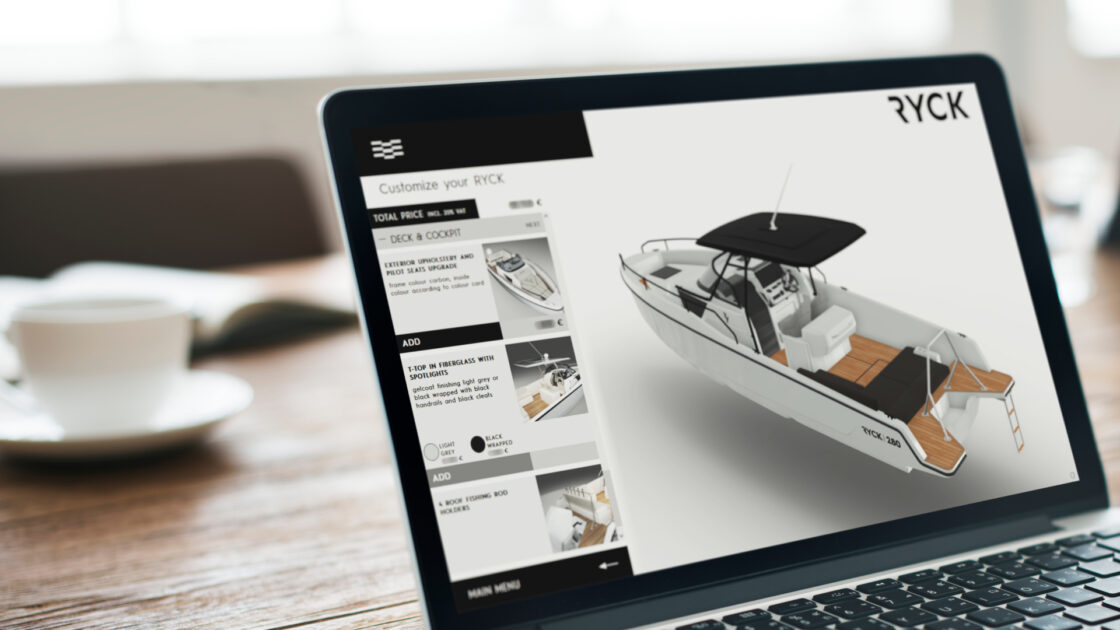
A 3D product configurator is an interactive tool, typically embedded on a website or used in a sales environment, that lets a user build, customize or personalize a product in real-time 3D. Every choice the user makes is reflected instantly in the 3D viewer: a different material, a new component, a custom engraving. The result is a true-to-life representation of the exact product they are about to order.
Learn more about what a configurator is and how it works in aour dedicated article.
How does a 3D configurator actually work?
Behind the visual experience, three systems work together:
- A rules engine defines which combinations of options are valid, ensuring that what the shopper configures can actually be manufactured.
- A real-time rendering engine updates the 3D visual instantly as each choice is made, reflecting accurate materials, textures and lighting without requiring a page reload.
- A pricing and data layer updates costs dynamically and, once the configuration is complete, can pass the full specification directly into order management or production systems.
In practice, you don’t have to hire a team of developers and 3D experts to set up and manage a configurator. Platforms like Emersya provide a no-code interface for defining product options, configuration rules and pricing, then automatically generate an embeddable configurator experience once the setup is complete.
What key features should a 3D product configurator have?
The depth and quality of features varies significantly between product configuration software platforms. A truly integrated solution goes well beyond a basic visualization tool. Here are the key features to look for:
- True-to-life real-time 3D rendering — accurate materials, textures, lighting, at every zoom level, without compromising on loading speed
- Intuitive, responsive user interface — a customization options explorer that works just as well on mobile as on desktop or in-store touchscreen
- Dynamic pricing — real-time price updates with every configuration change, so the customer always knows exactly where they stand
- Automated data output — a complete order summary or quote, including selected options, preview images, pricing, ready to send or process without manual preparation
- API connectivity — seamless integration with your existing CMS, PIM, ERP or OMS to keep your entire stack connected
- No-code management platform — the ability for your team to create, update, publish configurations independently, without engineering support
Learn more about how to choose the right product configuration software in our dedicated article.
How does a 3D product configurator improve the customer experience?
1. Shoppers can explore all options independently and buy with confidence
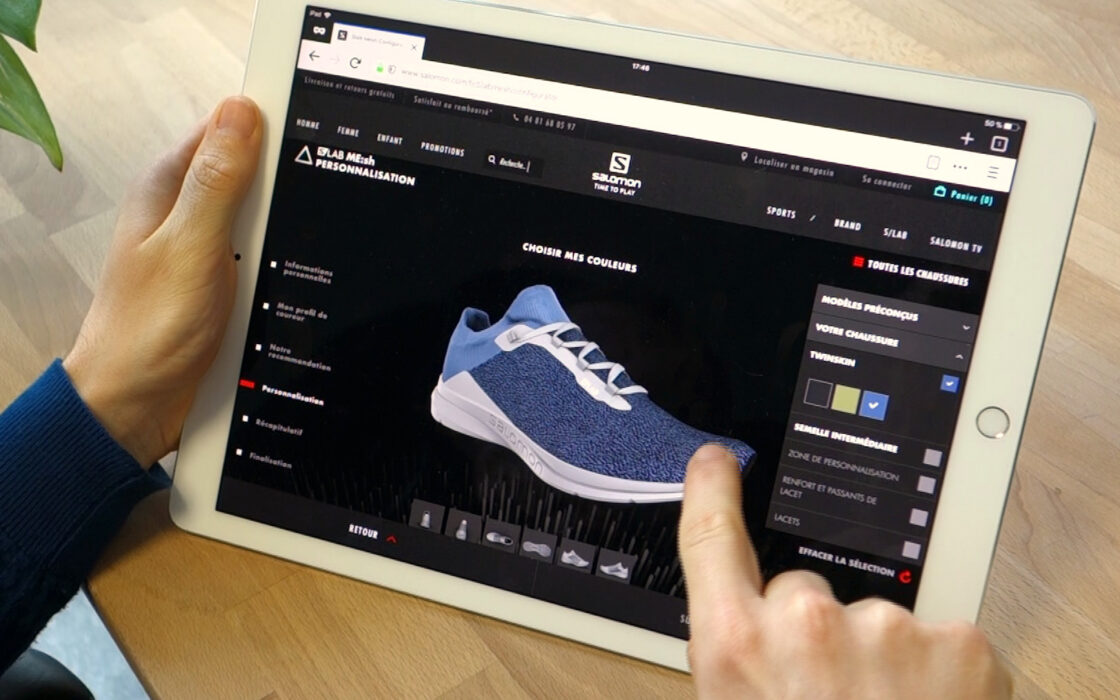
The foundational benefit is real-time visualization that makes it genuinely easy for shoppers to navigate all available options on their own. Instead of scrolling through product grids, static images or SKU lists, they interact directly with the product (rotating it, applying materials, switching components) and see the result of every choice as they make it.
This matters most for higher-priced or complex products, where uncertainty is the primary obstacle to purchase. A shopper who can see exactly what they’re ordering before they commit doesn’t need to guess, call your sales team or abandon the page out of doubt. The gap between expectation and reality closes and with it, the hesitation that blocks conversion.
Across different product categories and configurator providers, brands consistently report an average conversion rate uplift of around 30% compared to standard product pages. Although the exact stats vary depending on rendering quality, UX and product complexity, the positive impact of product configurators on conversion remains consistent.
2. From passive browsing to active creation
There is a fundamental difference between scrolling through a product catalog and visually building your own product. One is passive browsing; the other is a personal, interactive experience.
When a shopper uses a visual product configurator, they are not just selecting customization options. They are making decisions, seeing the results and refining their choices. That active involvement creates a sense of ownership over the final product before the order has even been placed. The result: customer engagement increases, uncertainty decreases and customer satisfaction with the purchase decision rises. For brands, this translates directly into enhanced customer loyalty and a higher likelihood of repeat purchase.
The best online shopping experience is one where the customer feels in control. A configurator is one of the most effective tools available for delivering exactly that.
3. Transparency at every step of the decision
One of the most consistent sources of friction in the purchasing process for configurable products is pricing uncertainty. Shoppers want to know what their current selection costs before they commit to the next step. When that information isn’t immediately available (i.e. when they have to request a quote, wait for a callback or navigate to a separate page), the buying journey stalls.
A well-built configurator eliminates this friction entirely. Dynamic pricing updates in real time with every selection, so the shopper always knows exactly where they stand. For B2B buyers, a CPQ-integrated configurator can go further, generating an accurate price quote automatically from the completed configuration.
At Emersya, we also know that important decisions aren’t always made straight away. That’s why our configurators offer shoppers the option to save their configuration, share it with a friend or a colleague for a second opinion, then return to it when they’re ready to commit. That ability to pause, reflect and revisit (without losing their work) removes a significant obstacle at the moment of decision, particularly for high-value or customized products.
4. A consistent experience across every channel and device
A shopper might first encounter a product on a brand’s website, explore it further on a mobile device during their commute, then discuss it with a sales rep in a showroom. At every one of those touchpoints, the product should look and behave the same way.
This omni-channel consistency is something a static image library simply cannot deliver at scale. Every channel requires its own set of visuals and keeping them aligned as products evolve is a significant operational challenge. A 3D product configurator built on the Emersya Platform uses a shared asset library designed to resolve this problem. The same 3D assets that power the eCommerce experience can be deployed on an in-store touchscreen, embedded in a sales rep’s tablet, shared via a direct link or used in a B2B self-service portal.
For the customer, this means a seamless, coherent user experience regardless of where or how they engage. For the brand, it means one set of assets managed in one place, deployed everywhere.
How can a product configurator boost sales?

1. Higher conversion rates
Across different industries, product configurator software providers and implementation types, brands that deploy well-executed 3D configurators consistently report a conversion rate uplift of around 30 to 40% compared to standard static product pages. Some implementations in high-complexity categories report significantly higher gains.
The range matters. Results depend on rendering quality, the intuitiveness of the user interface, how well the configuration options map to real customer preferences and the depth of integration with the wider eCommerce experience. A poorly implemented configurator (slow to load, visually unconvincing or difficult to navigate), can underperform a good product page. The configurator is a powerful tool, but its impact is proportional to the quality of its preparation and integration.

2. Higher average order value through visible upselling
When premium options and upgrades are shown visually rather than listed in a dropdown, shoppers understand their value immediately. The difference between a standard finish and a premium one becomes obvious the moment they see it applied to their product in real time. A higher-grade material, a refined colorway, an additional component: each feels like a natural choice rather than an upsell.
This is one of the more underestimated commercial benefits of a product configurator. The shopper is already invested in building their ideal product. Presenting better options visually, at exactly the right moment in that process, is far more effective than any static recommendation widget.

3. A shorter, more autonomous buying journey
For products that typically require back-and-forth with a sales team, a configurator fundamentally changes the dynamic. Shoppers can self-serve to a confident, validated configuration before they ever contact anyone. By the time they reach your sales team, they already know what they want.
That shift has a direct impact on sales cycle length and on the quality of conversations your team is having. Sales reps can focus on closing hot prospects rather than explaining options to lukewarm leads. Plus, the rules engine prevents invalid combinations from ever being selected, avoiding configuration errors that would otherwise require manual correction downstream.

4. Automated order summaries and quotes
While we typically focus on the benefits of front-end experience, some of the most significant operational benefits of a product configurator happen on the back-end.
For products sold directly online, the best configurators automatically generate:
1. A complete order summary with real-time pricing
2. A downloadable PDF or spec sheet for checkout confirmation and order fulfilment
3. All the structured data needed to process and track the order downstream
For products that need to be quoted before purchase (common in B2B or made-to-order contexts) a configurator can automate quote generation entirely. Instead of a sales rep manually compiling options and pricing then generating product visuals after a call, the configurator can generate a pre-formatted quote, complete with high-res visuals of the configured product, ready to send to the client. This generates streamlined sales and removes a significant source of delay, human error and back-and-forth between the customer and your team.

5. Fewer returns driven by a clearer purchase decision
For brands that accept returns, a mismatch between what a customer expected and what arrived is costly, both in terms of the logistics and operations, as well as the impact on customer trust. Empowering shoppers to build the product themselves and preview a true-to-life visual before ordering ensures there are no surprises upon delivery.
It’s worth noting that this benefit is most significant for brands selling made-to-order or personalized items, where returns carry a disproportionate operational cost due to re-manufacturing, re-shipping and margin erosion.
How do real-time 3D product configurators help manage large numbers of SKUs at scale?
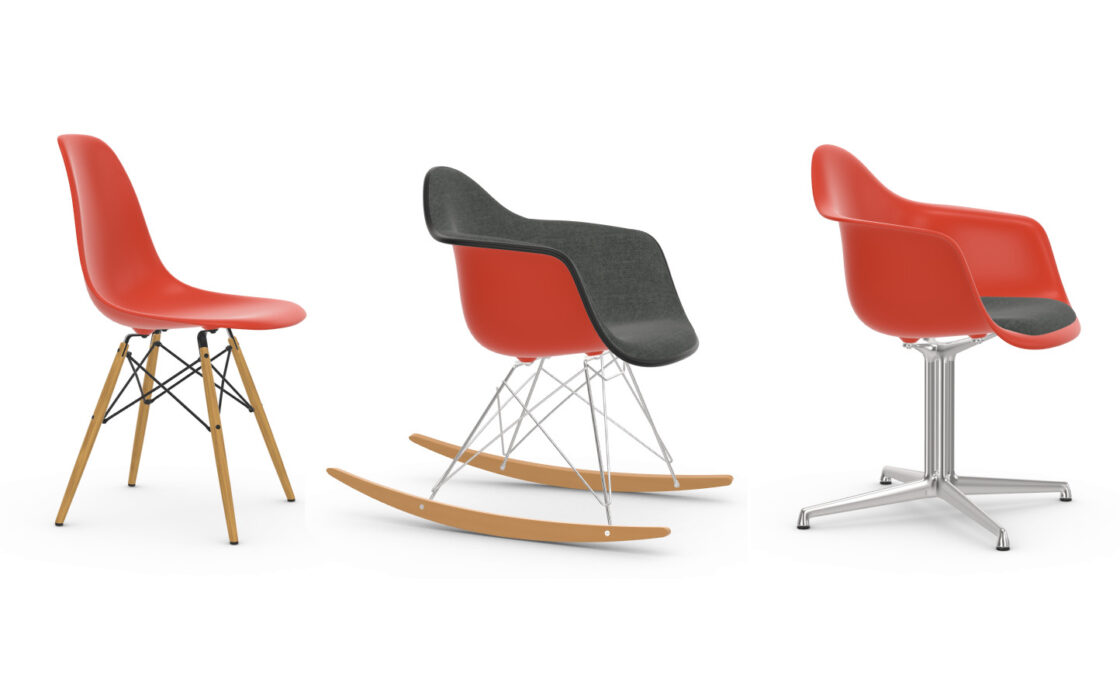
For products with a large number of options or customizable parts, real-time 3D is often the only feasible way to show customers what each possible combination actually looks like. Here’s why: Take a chair with three configurable parts: the seat, the base and the feet. Offer three options for each and you already have 3x3x3 = 27 possible combinations. That’s 27 images to prepare to show each product configuration form just one viewpoint!
Now add a seat cushion with 10 available fabrics: 3x3x3x10 = 270 images. Add a second viewpoint and you need 540. The numbers compound quickly and so do the cost and time required to prepare each image (and each physical product if you were planning on sticking with photography). Fixed 3D renders are faster than photography, but they don’t solve the underlying problem. Every combination still has to be calculated and rendered individually. For a catalog with genuine complexity, the preparation time quickly becomes prohibitive.
Real life example: Vitra’s Designer Furniture configurators
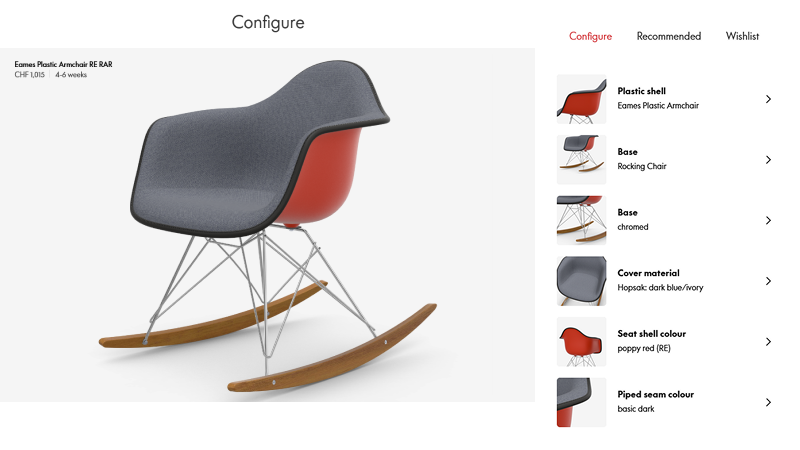
This is exactly the situation Vitra faced. The brand had been using pre-calculated 3D renders to show the available configurations for their iconic chair collections. When they decided to expand the options on their famous Eames Plastic Chair, they ran the numbers on what that would require using their existing method. The result: preparing all the necessary renders for all possible combinations, from multiple viewpoints, would have taken the equivalent of several centuries just in calculation time. Real-time 3D became the only viable option.
Vitra now uses the Emersya platform to power configurators across their entire product range: from design and office chairs to complex modular sofa collections. Their customers can explore millions of product configurations from any angle, in real time, at the click of a button. What would have taken centuries to pre-calculate is now generated instantly, on demand, directly in the browser.
The operational benefit extends well beyond the initial setup. When a material is updated, a new finish is added or a component is discontinued, the change is made once in the shared 3D asset library and propagates automatically across every product experience that references it. There are no individual image assets to update, no photo shoots to reschedule, no renders to recalculate. The configurator doesn’t just improve the shopping experience, it fundamentally changes how product visual management works at scale.
What is the role of product configurators in manufacturing?
The customer-facing benefits of a 3D product configurator tend to dominate the conversation. But for brands that manufacture complex, configurable or made-to-order products, some of the most significant gains happen further downstream, in the processes that connect a customer’s order to the production line. This section is particularly relevant for product, operations, and IT stakeholders involved in the buying decision.
Can a configurator support a made-to-order business model?
For brands that want to move towards or scale a made-to-order manufacturing model, a configurator is not just a front-end enhancement. It is the operational infrastructure that makes the model viable.
The traditional constraint of made-to-order is that you cannot sell what you cannot show. Without a way to visualize every possible configuration, brands rely on physical samples, sales rep expertise or a limited catalog that doesn’t reflect the full range of what they can produce. A 3D product configurator removes that constraint entirely. Customers can explore, build and order any valid configuration, seeing a true-to-life representation of the final product before a single item has been manufactured.
Connected to ERP systems and production workflows via API, the configurator passes the completed specification directly to the production line. Inventory management improves because production is driven by actual orders rather than demand forecasts. Lead times shorten because the order arrives production-ready, without a manual data entry step in between. The entire supply chain benefits from the reduction in configuration errors that a rules-based configurator delivers upstream.
How does a configurator connect the customer order to the production line?
In a traditional made-to-order workflow, the path from a customer’s choices to a production-ready order involves multiple manual steps: transcribing specifications, checking compatibility, generating a bill of materials, preparing production files. Each step is a potential source of error. Each error is a potential source of delay, re-work or wasted material.
A 3D product configurator integrated with ERP, OMS or order management systems removes this chain of manual interventions entirely. The integrated rules engine validates every combination at the point of selection to ensure that the configuration can actually be manufactured before the customer places an order. The order data flows directly into the production system without manual re-entry, reducing errors and boosting operational efficiency. Bills of materials are generated automatically from the customer’s selections to reduce workload.
The result is a production process that is faster, more accurate, less dependent on individual knowledge — and far more scalable.
Facilitated order management and production file generation
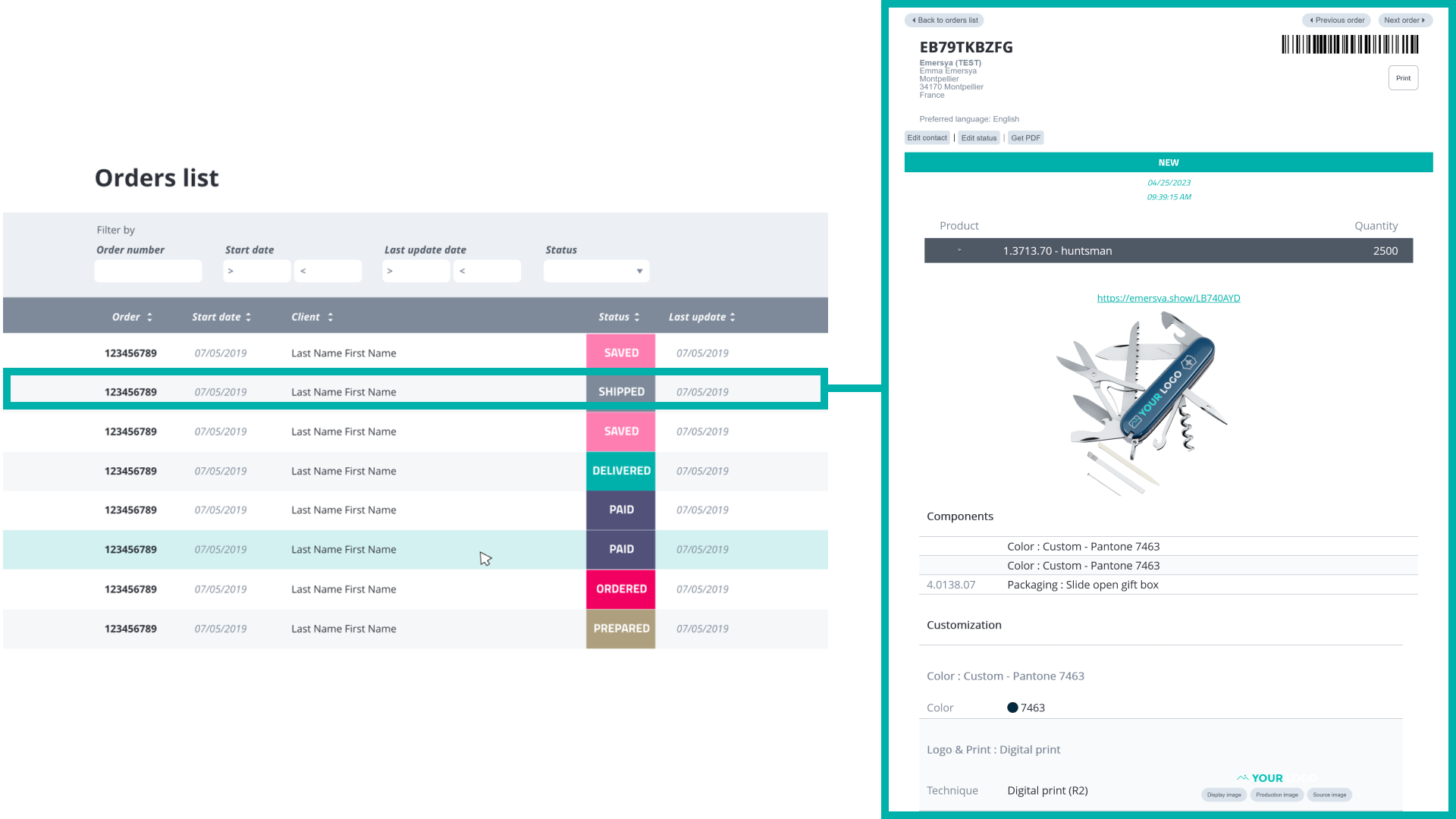
Once an order is confirmed, the manual step that typically sits between the customer’s choices and the production line is one of the most error-prone parts of the entire process. In made-to-order and personalization workflows, the manual preparation of production files, transferring specifications and matching custom content to the right order, lead to costly mistakes and delays.
The best 3D product configurators eliminate this bottleneck entirely. Platforms like Emersya can automatically generate production-ready files for each custom order (including print-ready text and images for engraving, printing and other personalization techniques) without any manual preparation. Orders are centralized in an integrated order management system where the production team can access each order, review the selected options and download the files needed to prepare the custom product.
For brands running high volumes of custom or personalized orders, this automation is so much more than a convenience feature. It’s the operational foundation that makes scaling a made-to-order business model viable.
Which types of products benefit most from a 3D product configurator?
Now that we’ve covered what a 3D product configurator is and what it delivers, it’s worth asking: does it apply to your products? The following product types are the best candidates for reaping the benefits of a 3D configurator.
1. Products with multiple material, color or finish options
This is the most common and obvious use case. Furniture, sports equipment, electronics, fashion accessories, luxury goods, household appliances, any product where the buyer’s choice of material, color or finish is central to the purchase decision is a natural fit for a configurator.
The core problem with static product pages for these categories is that swatches and dropdowns ask shoppers to imagine the result. A burgundy sofa in a thumbnail gives very little sense of how that color looks like at full scale, in a specific upholstery texture, with metal or wooden legs. A 3D configurator shows the actual combination, in real time, from every angle. It removes the guesswork that causes hesitation and, ultimately, abandoned carts.
2. Products sold made-to-order or configure-to-order
For complex or technical products (e.g. industrial equipment, custom machinery, high-specification B2B goods…) the traditional buying journey relies heavily on a sales rep who knows the product inside out. That creates a bottleneck. It limits your sales capacity to the availability of your team and forces buyers who already know what they want to wait.
A configurator with a well-built rules engine guides the buyer through every valid combination, prevents incompatible selections and delivers a fully specified, manufacturable configuration at the end of the process. Sales conversations shift from product education to deal closing. For brands looking to scale their made-to-order business without scaling their sales headcount proportionally, this is one of the most compelling arguments for investing in a configurator.
3. Products built from modular or interchangeable components
Storage systems, modular seating, office furniture, architectural products, sectional sofas… These are products where the buyer isn’t choosing from a fixed catalog but building something from a set of parts that can be assembled in different ways. The number of possible outcomes can quickly become overwhelming. No static image library can represent a near-infinite range of possibilities.
A modular configurator lets the shopper drag, drop and connect components in real time, seeing the assembled result as finished product. This enables them to try out all the possibilities for themselves in an enjoyable and visual way. The combination of a rules engine with an interactive 3D viewer makes the configuration process intuitive and helps customers understand which components are compatible and how they can be put together.
4. Products that can be personalized with custom content
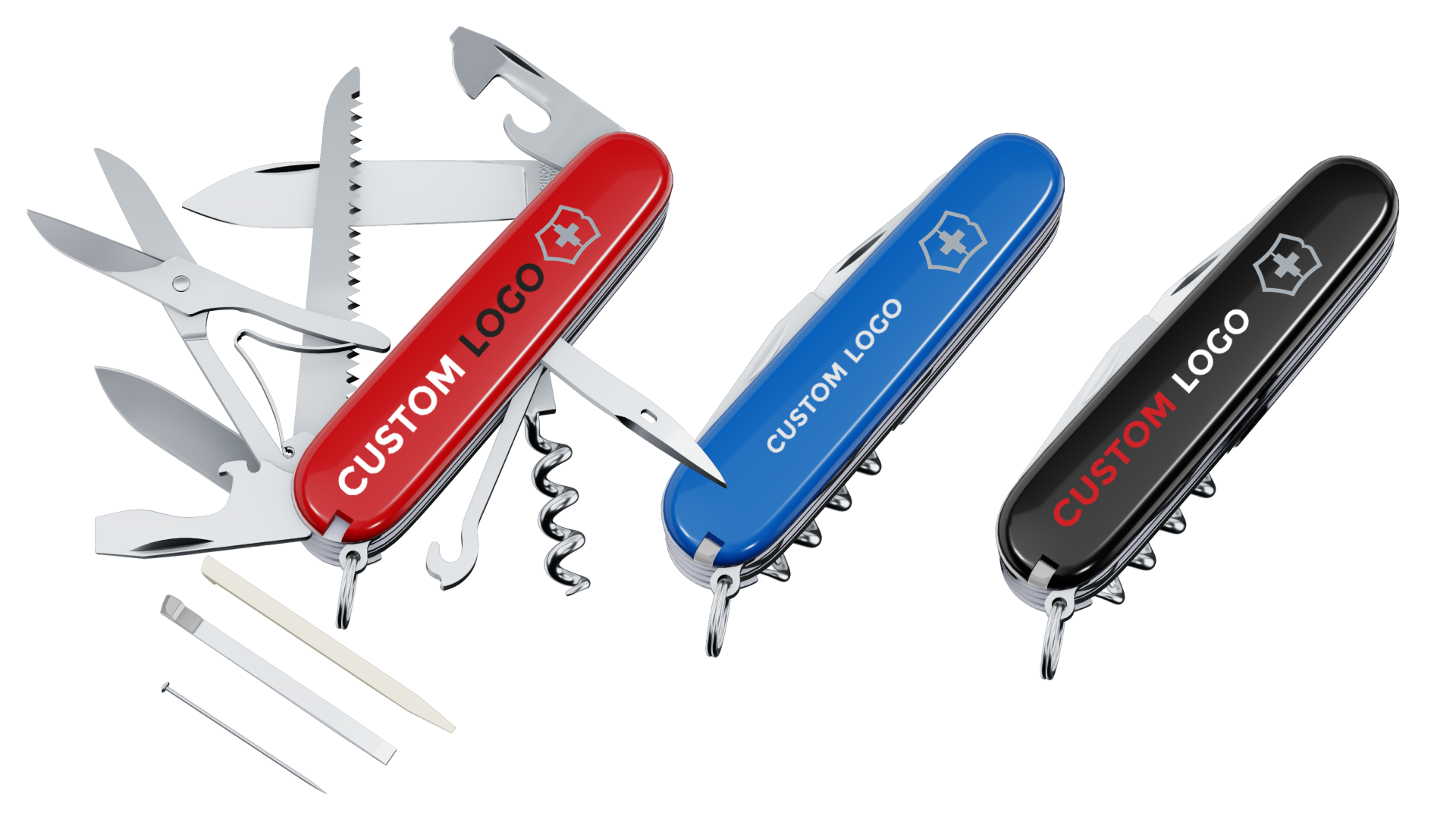
Engraving, embroidery, printed logos, custom text, uploaded images applied to a product surface… personalization in this sense is distinct from configuration, but the configurator serves both. The shopper adds their own content and sees it rendered in real-time 3D on the actual product before ordering.
Beyond the customer experience benefit, this category is where the production file automation discussed earlier is most directly valuable. The configurator captures the personalization data, generates print-ready files in the correct format and passes them directly to the production workflow. What would otherwise require manual file preparation for every single order is handled automatically, at scale.
Conclusion – Why use a product configurator for eCommerce?
A 3D product configurator is not a feature addition to a product page. For brands selling complex, configurable or personalizable products, it is the mechanism through which the shopper understands, builds confidence in and commits to a purchase that static content simply cannot support.
The benefits we’ve explored throughout this article (like higher conversion rates, stronger average order value, shorter sales cycles, fewer production errors, more autonomous buyers, automated order-to-production workflows), are not isolated gains. They are interconnected. A shopper who builds their own product buys with more confidence, orders more accurately, returns less and comes back again. Customer loyalty is not built through a single touchpoint. It is built through a shopping experience that respects the buyer’s intelligence and meets their customer expectations at every step.
But the configurator’s value is proportional to the quality of its implementation. Rendering quality, the accuracy of the rules engine, the depth of integration with your production and commerce systems, all of these determine whether you get the results described in this article or fall short of them. A configurator with poor rendering quality or a hard to use UI can underperform a well-designed static product page. The decision is not just whether to deploy a configurator. It is which platform to trust with the complexity of your products.
Emersya has spent over a decade helping 100+ brands, from global industry leaders to ambitious SMEs, build 3D product configurators that genuinely deliver on the promise of the benefits we’ve discussed. Our proprietary real-time 3D rendering engine is built to produce true-to-life visuals for even the most complex materials and premium products. Depending on your needs and resources, you can deploy a configurator using our intuitive auto-generated interface in a matter of days, or work with our expert UX team to design a fully custom experience built on our comprehensive API. Either way, the same platform handles what comes next: deep integration with your existing tech stack via API and / or centralised order and production file management through Emersya’s own Order Management Solution.
If you’d like to see what this could look like for your specific products, we’d be happy to walk you through it in a 30-minute discovery call. No pitches, just a practical, honest conversation about what’s possible.
DEMO
Make complex products easy
to configure and sell
Contact our team today to discover how Emersya can help you build a successful 3D product configurator.


Frequently Asked Questions
This is one of the most common doubts we hear from brands with sophisticated product lines: “Our product is too complex to digitize properly” or “Real-time 3D won’t do justice to the quality of what we make.”
Both concerns are understandable, but neither reflects where real-time 3D rendering technology is at today. High-fidelity rendering engines can now realistically reproduce the look and feel of complex material textures such as the soft sheen of suede or velvet, the fluffiness and volume of fur, the reflection and refraction of precious stones. Unlimited zoom, interactive animations and exploded views allow a configurator to communicate technical details and internal components in ways that no static image ever could.
The commercial benefits of a 3D product configurator are not limited to consumer eCommerce. For sales teams operating in B2B environments (selling to distributors, specifiers, corporate buyers or resellers) a configurator is one of the most effective sales process tools available.
Instead of presenting a PDF catalog or a static slide deck, a sales rep can walk a client through every available option in real time, building the product together during the meeting. The visual feedback is immediate, the configuration is validated automatically and the resulting specification can be converted into a price quote or a formal proposal without any additional manual steps. This approach is particularly effective for industrial equipment, office furniture, technical products and any category where the buyer needs both expert guidance and a visual representation of the options to understand exactly what they are ordering before committing.
One of the most underappreciated aspects of a well-built 3D product configurator is that it is not a single-channel tool. The 3D assets, customization process and configuration logic can be adapted for and deployed across every channel where your products are sold or presented.
On your eCommerce website, it drives enhanced engagement and self-service conversions. In the hands of a sales team, it becomes a live demonstration tool. In a showroom or at a trade show, it runs on a touchscreen and lets visitors visualize a complete product catalog. In a B2B portal, it enables distributors to configure, quote and order independently. Shared via a direct link, it lets a buyer send their saved configuration to a decision-maker for sign-off.
With the Emersya Platform, it is even possible to generate different version of the configurator for retailers and distributors that only want to offer a specific selection of product options and set their own prices! One investment, significant returns across all of your retail channels.
A few years ago, offering a 3D product configurator on your eCommerce site was a competitive advantage. Something that set you apart, generated press coverage and gave buyers a reason to choose your website over a competitor’s.
That window has not closed entirely, but it is narrowing. The product configurator software market was valued at approximately USD 1.28 billion in 2026, growing at 7.8% CAGR through 2035[1]. This shows that more and more brands and manufacturers are investing in product configurators to reap all the benefits we’ve discussed. Meanwhile, customer expectations around product personalization and digital shopping experiences continue to rise. Research from McKinsey[2] consistently shows that the majority of consumers now expect the brands they buy from to offer personalized experiences.
FREE RESOURCE
3D Configurator Project Planning Template
Use our ready-to-fill, 20-question template to map out your project in under an hour and build a budget-safe, fully aligned plan from day one!